
Air Duct Cleaning: Repair or Replace? How San Clemente Homeowners Decide
Most San Clemente homeowners facing a duct problem get handed two options: a cleaning, or a full replacement. The right answer usually sits between them, and it depends on three conditions you can actually verify. Full duct replacement in a San Clemente home typically runs $3,000 – $8,000, and it’s sometimes sold as the only fix when targeted repairs and pressurized sealant would have solved the same problem for well under $1,500. Our technicians have up to 10 years of experience, and the pattern we see is consistent: the decision gets made on a visual glance instead of a pressure test. If you’d rather not sort through it alone, call (866) 371-4884.
What are the three conditions that actually justify duct replacement?
Replacement is a legitimate answer, but it has to be earned. In our experience, there are three specific conditions that push a San Clemente duct system past the point where repair holds. Everything else is usually fixable.
- Duct board that has delaminated throughout. Fiberglass duct board can fail at the seams and inner facing. A single soft spot gets cut out and patched. Board that has gone soft across most of the run can’t hold a seal, and patching it becomes a slow leak-chasing exercise.
- Flex duct compressed more than 30% across the system. Flex duct loses capacity when it’s kinked, crushed, or strung tight around a corner. One bad run is a reroute. When most of the system is squeezed below three-quarters of its rated diameter, airflow and static pressure are compromised in a way cleaning won’t recover.
- R-value loss that drops the system below code minimum in a conditioned attic space. Insulation value on duct runs degrades when the jacket is torn or compressed. If enough of the system sits below what your local building department requires for ducts in conditioned space, replacement may be the cleaner path. Your city’s building department is the right source for the current requirement – we won’t guess at a number for your address.
If your system doesn’t meet all three, repair and sealing deserve a serious look before anyone writes a replacement quote. In San Clemente, most homes we assess land in the repairable column.
Why does a duct leakage test come before any repair-or-replace decision?
No repair-or-replace conversation should happen without a duct leakage test, because visual inspection alone misses most of the problem. A technician looking up at accessible ductwork sees the runs, the joints, and the obvious tears. What they can’t see is what’s happening behind drywall chases, above ceiling cavities, and at the plenum transitions where pressure loss concentrates.
A blower door or duct blaster test measures how much air the system loses under pressure. It gives you a number, not an opinion. That matters for three reasons:
- It establishes whether your ducts are leaking at all, and how badly.
- It gives you a baseline to measure against after repairs, so you can see whether the work changed anything.
- It separates an airflow problem from a contamination problem – two very different fixes.
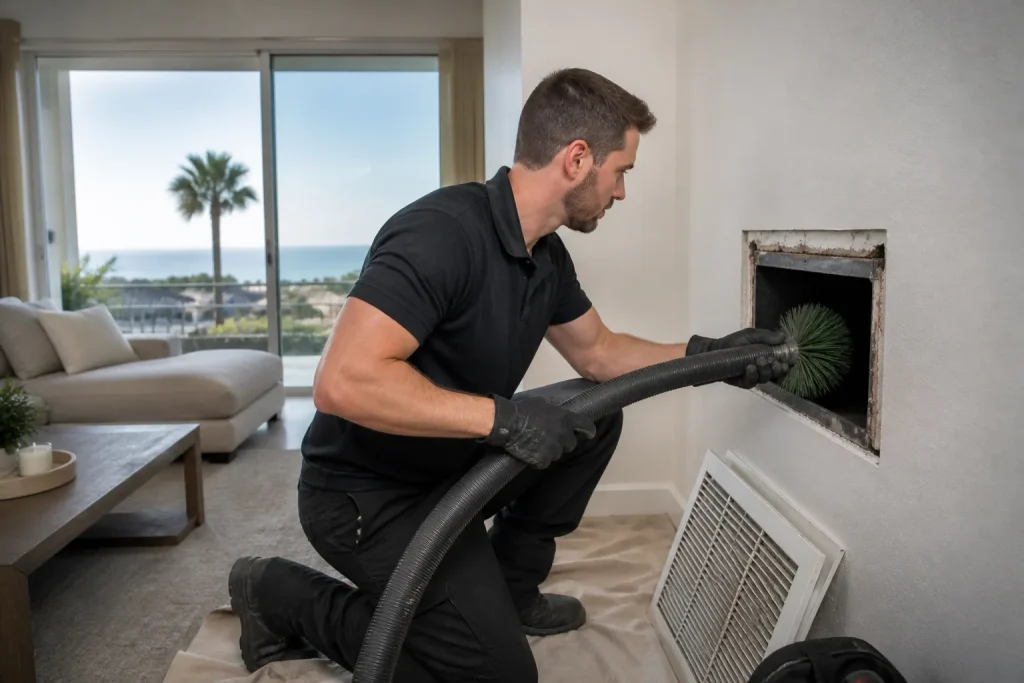
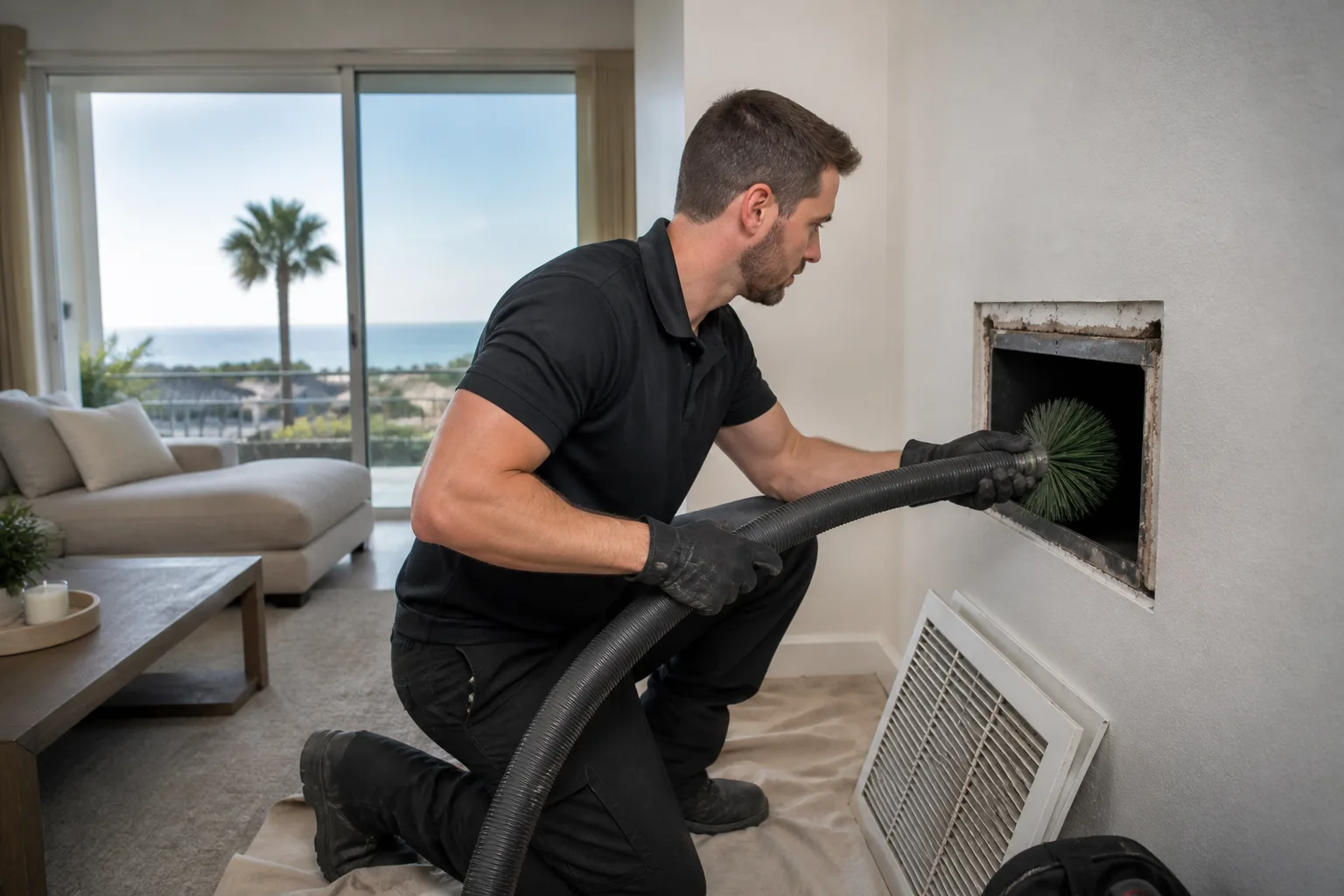
Without that measurement, a replacement recommendation is essentially a guess about what’s behind the drywall. In our experience, a pressure test frequently reveals leakage pathways that no amount of crawling around in an attic would have found. It’s the same reason we rely on Rotobrush and Nikro systems for the cleaning itself: purpose-built equipment gives you a documented result rather than a visual impression.
How does Aeroseal change the repair calculus?
Aeroseal is a pressurized sealant application that finds and closes leaks from the inside of the duct system. It changes the math for San Clemente homeowners because systems that couldn’t hold a seal with mastic and tape alone can often be brought back to an acceptable leakage rate with sealant injected under pressure. The sealant seeks the leaks the way air does.
Where it matters most:
- Leaks in runs you can’t reach. Ductwork buried in wall chases or run above finished ceilings is a bad candidate for hand-sealing and a good candidate for pressurized sealant.
- Many small leaks rather than a few big ones. Aeroseal handles distributed leakage well. A single large disconnected joint is still a mechanical repair.
- Systems that are structurally sound but porous. If the duct material is intact and the R-value is adequate, sealing can close the gap between where the system sits and where it should be.
Aeroseal isn’t a rescue for failed duct board or crushed flex duct – it needs something sound to seal against. But when the three replacement conditions above don’t apply, it’s often the step that makes a $900 clean-and-seal hold for years instead of months. Pairing it with a proper air duct cleaning means the sealant goes onto a clean surface, and the cleaning reaches the contamination that sealing alone won’t remove.
How do you compare a clean-and-seal against a full replacement?
Do it as cost per year of remaining service life, not as a single invoice. A clean-and-seal that runs around $900 against a replacement that runs $5,500 looks like an easy call – until you weigh how long each option actually lasts.
A worked comparison, kept general:
- Existing system around 12 years old, otherwise sound. A $900 clean-and-seal that buys several more years of service works out to a few hundred dollars a year. Replacement at $5,500 spread over the same window costs several times more annually. Repair wins here by a wide margin.
- Existing system around 22 years old, with board delamination or widespread flex compression. A $900 repair that buys a year or two before the same problem returns is $450 – $900 per year against a $5,500 replacement that should serve for two decades or more. Replacement wins here.
The crossover point is roughly wherever the repair’s remaining life in years stops being worth the price. That’s a judgment call, but it’s a call you can make with your technician once a leakage test gives you real numbers. Our HVAC cleaning service pairs with this evaluation because the air handler and coil condition often tell you how hard the duct system has been working.
What role does duct material play in San Clemente homes?
Duct material affects long-term repair viability, and in San Clemente’s mild climate the difference shows up over years rather than seasons. Fiberglass duct board, flex duct, and galvanized steel each age on their own schedule, and each is more or less forgiving when something goes wrong.
- Fiberglass duct board is the most sensitive. Its inner facing is where contamination and moisture first show up, and once that facing fails, patching gets progressively less effective. Board that’s been doing its job for a couple of decades may still be structurally useful – or it may be soft throughout. A pressure test and a hands-on inspection tell you which.
- Flex duct is durable but intolerant of bad installation. Compression and sharp bends are where it fails, and once a run is crushed it usually needs a reroute rather than a patch.
- Galvanized steel is the most repairable. Seams can be re-sealed, dents can be addressed, and the material doesn’t degrade the way board does. If your system is steel, repair is nearly always worth pursuing first.
San Clemente’s mild winters mean your system doesn’t fight the temperature swings that wear out ductwork in harsher climates, and that generally works in favor of repair. When cleaning turns up contamination that goes beyond routine dust – the kind that calls for serious capture equipment – we bring in Abatement Technologies gear, and we can install a Honeywell or Aprilaire filtration upgrade in the same visit so the cleaned system stays cleaner.
When should you call a pro?
Call a professional when you smell a musty odor that won’t clear, when dust builds up faster than it used to, when your energy bills climb without a change in usage, or when a contractor has recommended replacement and hasn’t measured anything. Those are the situations where a leakage test and a proper look at the duct material change the decision.
High-particulate or mold-adjacent situations need capture equipment and protective treatment, not a shop vac. Guardsman-grade protective treatments are available as part of our sanitizing service when the assessment calls for it. We also handle dryer vent cleaning and the full air pathway in one visit, so you’re not coordinating three contractors for one house.
Related services in San Clemente: duct repair and sealing, air quality and sanitizing, and HVAC cleaning – all handled by one crew, so problems found during cleaning can be corrected the same day.
The Bottom Line
Repair beats replacement unless your system meets all three conditions: delaminated duct board throughout, more than 30% flex compression across the system, and R-value loss that drops you below code minimum in conditioned attic space. Get a leakage test before anyone recommends replacement. Then compare cost per year of remaining service life rather than the invoice alone. In San Clemente, most homes are repairable, and a clean-and-seal with pressurized sealant is often the fix that lasts.
If you’re in San Clemente and need help, San Clemente Air Duct Cleaning Pros offers free estimates – call (866) 371-4884. We answer 24/7. Fast dispatch from 7am to 7pm, Sunday through Friday.
Frequently Asked Questions
Whole-system cleaning typically runs a few hundred dollars, while a clean-and-seal with pressurized sealant generally lands under $1,500. Full replacement runs $3,000 – $8,000. We quote one flat price per system after assessing the ductwork, and the written estimate sets the final price.
Cheap quotes often cover a surface vacuum of the accessible registers, not a full-system mechanical clean with a pressure test. The gap between a teaser price and a replacement recommendation that follows is exactly why we insist on measurement first. Call (866) 371-4884 for a free estimate.
Ask for the leakage test numbers before and after, and for before-and-after photos of your own ducts. A documented test result is the difference between a claim and a measurement. Call (866) 371-4884 to book an assessment.
Most homes do fine every several years unless you’ve had renovation dust, pets, or a moisture event. If you’re seeing faster dust buildup or musty odors, that’s your signal rather than a calendar. Call (866) 371-4884 and we’ll tell you what your system actually needs.
Written by the team at San Clemente Air Duct Cleaning Pros.
Need Air Duct Cleaning Help?
Call San Clemente Air Duct Cleaning Pros - the local pro we connect you with is licensed and insured, here with fast help in San Clemente.
(866) 371-4884